Sigmas
Two Brotherhoods, One Standard: Bryce Harris on Howard’s Historic March Moment, Leadership and Phi Beta Sigma

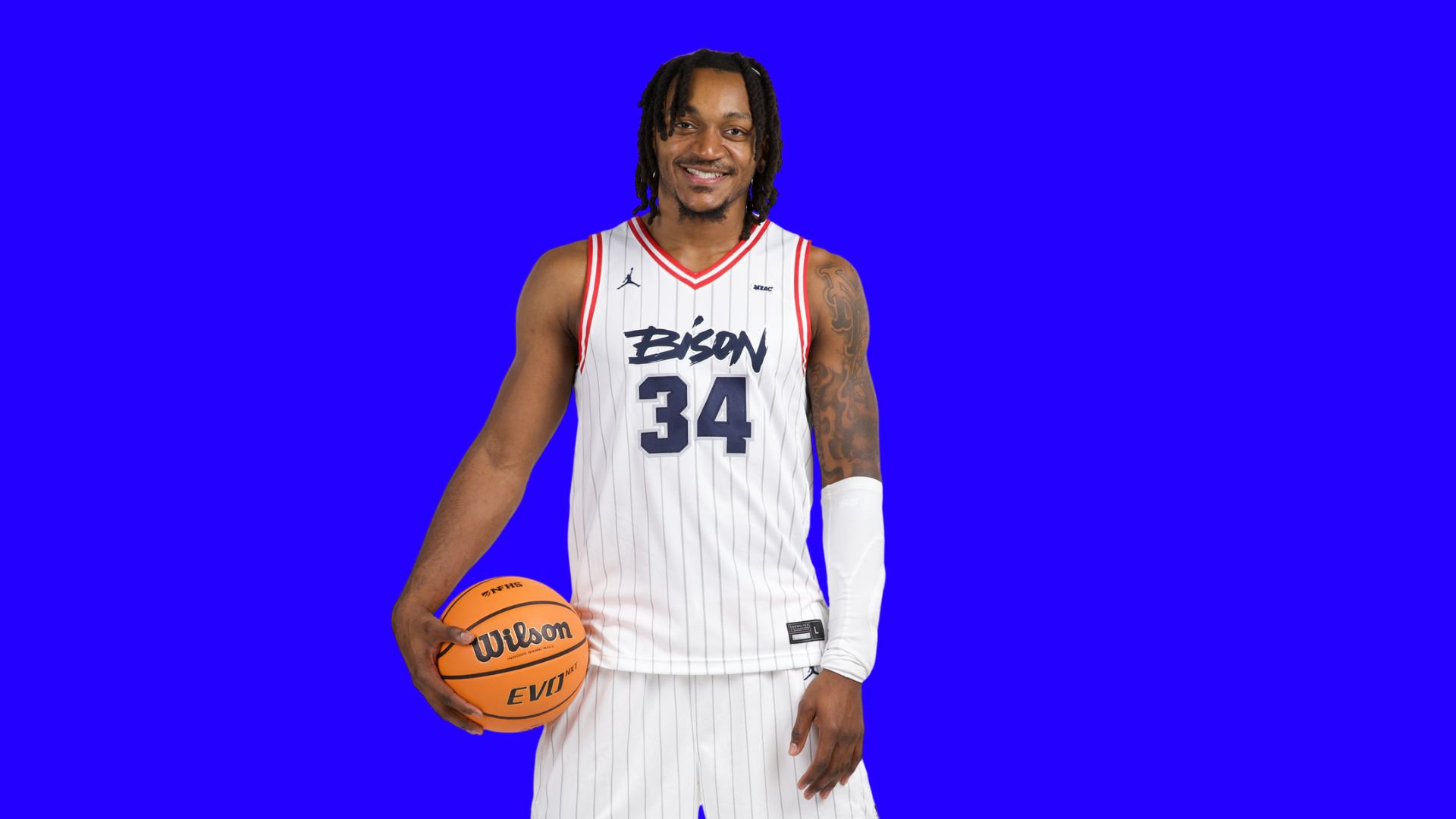
By Nicklaus Utsey for Watch The Yard
The ball left Bryce Harris’ hands with Howard’s season, history and nerves all hanging in the same breath.
There were 13 seconds left in Dayton, Ohio, and the Bison were trying to hold off UMBC in the First Four. Howard had been here before. The bright lights. The national stage. The weight of March pressing down on every possession. But this time, something was different.
Harris caught the ball with the shot clock bleeding down, turned toward the rim and rose into a jumper that he already knew was good.

“As soon as that thing left my hand, I knew that thing was cash,” Harris said.
The shot helped seal Howard’s 86-83 win over UMBC, giving the program its first NCAA Tournament victory. Harris finished with 19 points and 14 rebounds, and his late turnaround jumper became the defining moment of a night that pushed Howard into a new part of its basketball history.
But Harris’ story is not just about one shot.
It is about the years before it. The injury before it. The roles before it. The losses before it. The pressure before it. The brotherhood before it.
And when Harris talks about winning, he does not talk like someone who believes winning is just about talent. He talks like someone who has learned that winning asks different things from you at different stages of your life.
“I feel like the main thing that every player is kind of wanting to prove is that they’re winners,” Harris said. “And a part of being a winner is being able to handle adversity.”
That word, adversity, sits at the center of Harris’ basketball journey. Not as a motivational poster. Not as something polished up for interviews. For him, adversity has had different faces.
A different role as a sophomore. A different responsibility as a junior. A different weight as a senior.
“You see adversity in a lot of different shapes and forms,” Harris said. “The adversity I faced when I was able to win my sophomore year was different than the adversity I was able to face when we won my junior year. And the same principle goes the same way for this year, my senior year.”
Then he said the part that explains why the shot against UMBC mattered beyond the box score.
“I’ll do whatever it takes to win,” Harris said. “I’ve had three different roles on every single championship and NCAA Tournament run that I’ve had in my college career.”
That is the thing about Harris. The story is not simply that he became the guy. It is that he understood what it meant when he was not the guy yet. He had already learned how to fit into winning before he was asked to carry more of it.
Howard’s win over UMBC did not come out of nowhere. Under head coach Kenneth Blakeney, the Bison had already built momentum, winning MEAC titles and reaching the NCAA Tournament in 2023 and 2024 before the 2026 breakthrough.
Harris was there through that rise, learning the rhythm of a program that kept knocking until the door finally opened.
By the time Howard found itself back in Dayton, Harris understood the tournament differently. The conference tournament did not feel as heavy to him as it had in earlier years. Not because it was easy, but because he had learned the shape of winning.
“I kind of understood the formula for winning, because I’ve been there so many times,” Harris said. “I understand there’s certain things that championship teams need to be willing to do that other teams in the MEAC, in my opinion, weren’t ready to do yet.”
He had learned that winning is not always about working harder in the most obvious way. Sometimes it is about seeing the game before the game speeds up. Sometimes it is about knowing when to press and when to breathe. Sometimes it is about thinking before reacting.
“I feel like this is one of the easier years that I’ve won in the conference, just because I could think the game better,” Harris said. “Work smarter, not harder.”
That ability to think the game came from an uncomfortable place.
Harris said the biggest jump in his game this year was not physical. It was mental.
“This year, it wasn’t physical,” Harris said. “I’d probably say mental.”
He said he broke his foot the year before and had to sit out. Away from the motion of the game, he had no choice but to study it from a different seat.
“I was able to watch the game from my IQ standpoint,” Harris said. “I realized there’s areas that I can improve on from my IQ standpoint as well.”
Injury can make a player feel removed from the team. Harris used it as a classroom.
He watched angles. He watched timing. He watched how good players manufacture contact and how great players choose their moments. He learned the difference between a shot he could take and a shot the team needed him to take.
“A lot of good players are good at getting to the free throw line,” Harris said. “So I was able to improve in that. Also, knowing when to take certain shots, knowing the difference between a good shot and a great shot.”
That kind of growth does not always show up in a highlight first. Sometimes it shows up in calm. Sometimes in patience. Sometimes in a senior knowing exactly what a late-game possession needs.
Against UMBC, the game had all the ingredients that make March feel like March: a tight score, a roaring crowd, strangers wearing other schools’ colors, and a nervous energy that travels through an arena before anyone says it out loud.
Howard entered the night seeking its first NCAA Tournament breakthrough. UMBC cut the lead to two in the final minute, and Harris answered with the shot as the clock expired, stretching the advantage and helping Howard survive.
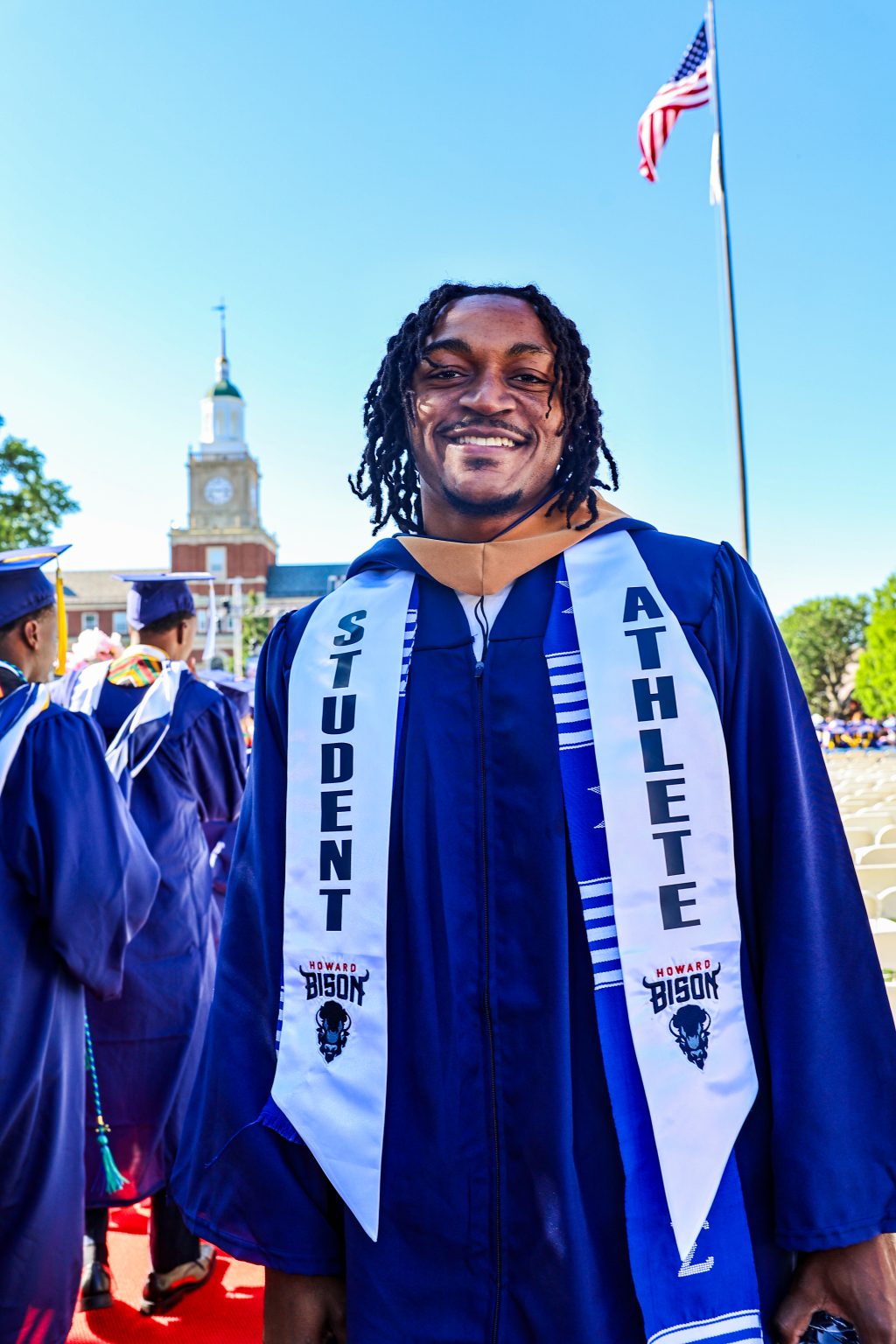
Harris remembered the sequence before his shot. UMBC had just hit a tough step-back three, and the building responded.
“One of their team hit a crazy step-back three,” Harris said. “That put them within two, and the crowd went stupid.”
Then came Harris’ answer.
“It was like catching it, like the shot clock going down, and I turn around jumping,” Harris said. “As soon as that thing left my hand, I knew that thing was cash.”
The sound after it dropped is what stayed with him.
“The crowd was just somewhere so loud where it felt like you couldn’t hear nothing,” Harris said. “That was one of the craziest points of my career.”
That is the beauty of March. One second, you are playing basketball. The next, you are inside a memory people will attach to a school forever.
Harris said he felt the weight of the moment before it was over. Somewhere around the second half, the game stopped feeling like just another game.
“You could kind of feel the energy of March,” Harris said.
He noticed people in the arena wearing Miami of Ohio jerseys, North Carolina State jerseys and Texas jerseys. They were not there just for Howard. Some were waiting for their own teams to play. But for those minutes, they were pulled into the Bison’s moment too.
“They’re cheering for us,” Harris said. “I felt we were their team too, just because they love basketball.”
That is when the game became bigger than Howard’s bench, bigger than the players on the floor, bigger than the people who had followed the Bison all season. For a moment, Howard had the room.
And Harris knew what that meant.
“Everybody’s telling us that before the game,” Harris said. “So we’re like, ‘Alright, well, we got history.’”
History can be inspiring. It can also be heavy.
Harris had felt the other side of that weight before. He mentioned Howard’s First Four loss to Wagner the year before, when the Bison were favored and did not finish the job. In 2024, Wagner defeated Howard 71-68 in Dayton, with Harris scoring 16 points in the loss.
So when Howard got another chance, the breakthrough felt different.
“Overcoming that, that was gratifying,” Harris said.
Still, the game was only part of the story. The deeper piece is what Harris became along the way.
After the win, after the crowd, after the late jumper, Harris reflected on how he had grown as a leader. He learned how to better understand people.
“I’d probably just say being able to adjust to everybody’s leadership styles,” Harris said.
Harris described himself as direct. He is not someone who hides what he thinks. But leadership forced him to learn that being right and being effective are not always the same thing.
“I’m very straightforward, direct,” Harris said. “But at the same time, you don’t want to do that so much to your team to the point where it’s like, ‘Okay, Bryce is just tripping.’ You really want to be able to get through to your teammates.”
That is the line a leader has to walk. Push too little, and the standard slips. Push without care, and people stop hearing you.
Harris said he learned that some teammates need to be challenged one way, while others need a different approach.
“Certain people you get on, they might shut down,” Harris said. “So you might talk to them a different way.”
It is a mature answer because it admits something a lot of leaders miss: accountability is not one-size-fits-all. The standard may stay the same, but the delivery has to know the person.
For Harris, that became especially important because this was the first year he felt like one of Howard’s main veteran voices.
“This is the first year that I was probably the main guy, like the oldest guy, to have a leadership role,” Harris said.
In previous seasons, he said he played under older voices like Jelani Williams and Seth Towns. Back then, leadership meant reinforcing what they had already established.
“I was a leader, but I was a leader under them,” Harris said. “I would make sure I’m aligned with what they said.”
This year, the responsibility shifted.
“This year, I was one of the main guys, and my coach expected me to be that guy to make sure that standard is met.”
That word, standard, is where Harris’ basketball life and fraternity life start to sound like the same story.
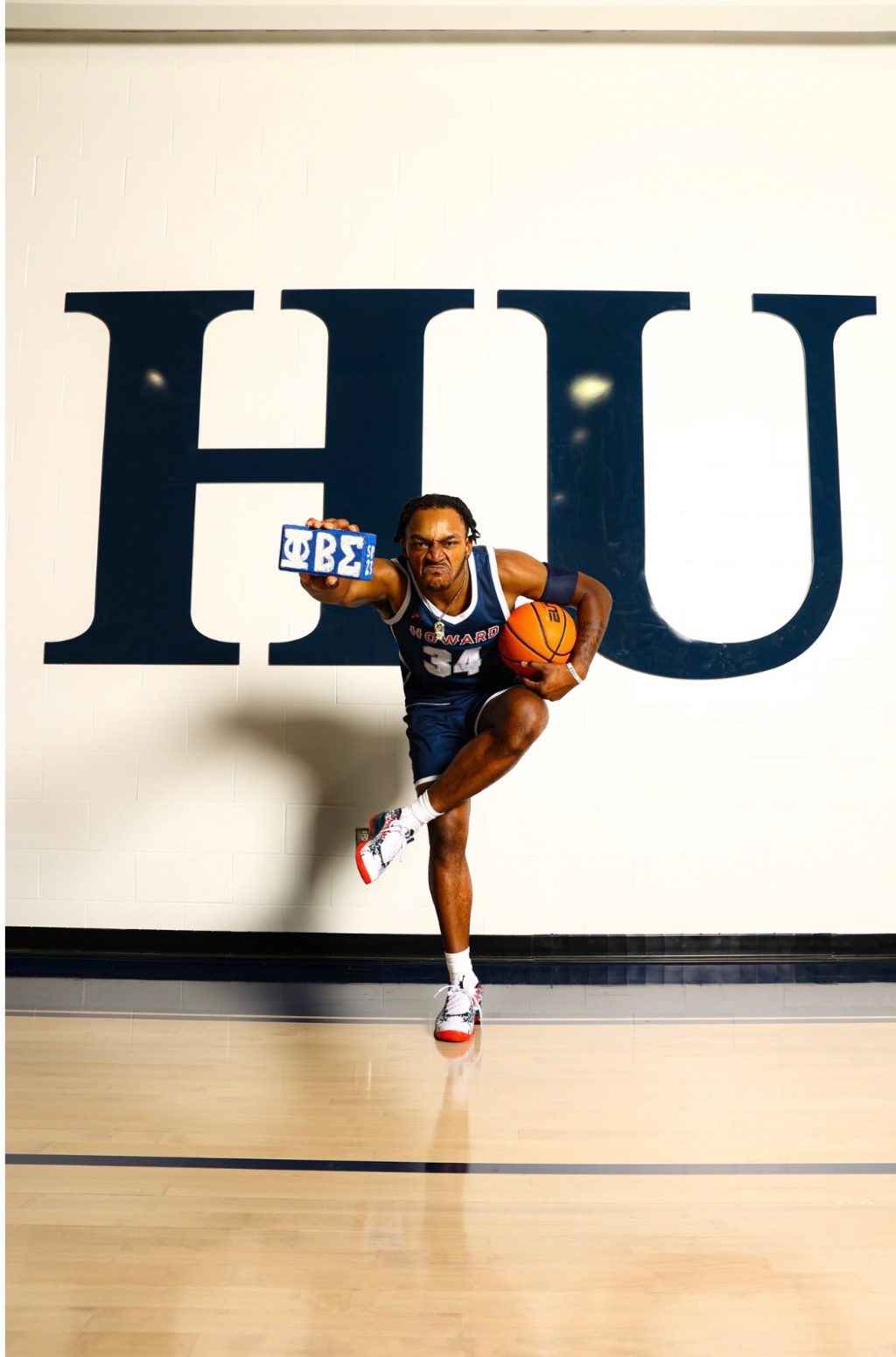
Harris is a Spring 2023 initiate of Phi Beta Sigma Fraternity, Inc.’s, Alpha Chapter, the oldest chapter in the fraternity. Phi Beta Sigma was founded at Howard University in 1914, by A. Langston Taylor, Leonard F. Morse and Charles I. Brown, with ideals of brotherhood, scholarship and service. The fraternity’s official history also describes its founders’ belief in being “a part of” the general community and serving an “inclusive we.”
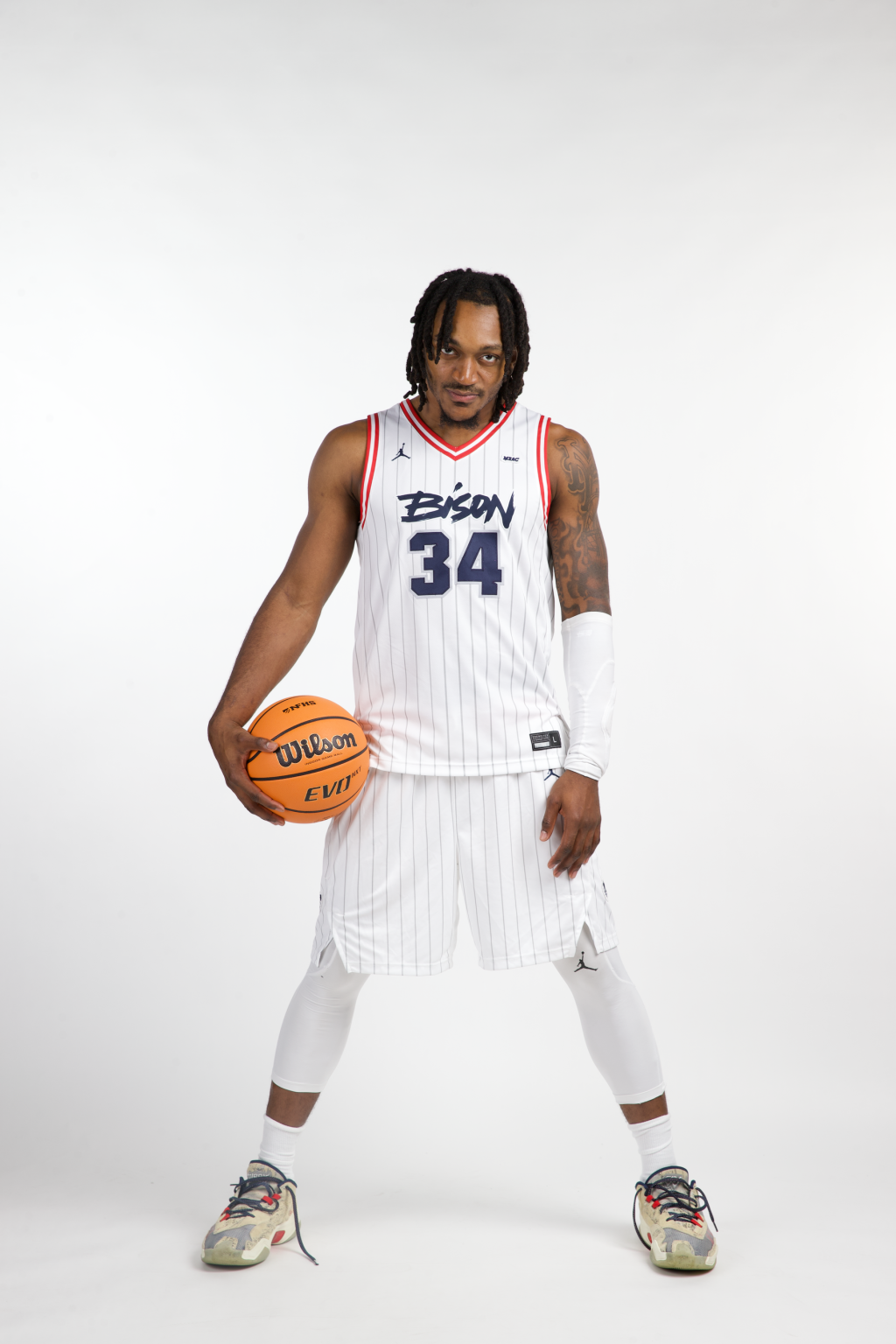
That history matters because Harris is not just a Sigma who happens to attend Howard. He is a Sigma at the place where the fraternity began.
For him, that means representation is not casual.
“You don’t just represent yourself or your family anymore,” Harris said. “You represent Sigmas all over the country.”
That responsibility changed how he carried himself.
“I’m not an individual,” Harris said. “My decisions and the choices that I make affect other people.”
That line could describe a fraternity. It could also describe a team.
And that is the point.
Harris said Sigma gave him a different understanding of friendship and closeness. Growing up, he said, he did not always have “best, best friends.” Brotherhood gave him a new lens.
“Having my line brothers and my frat brothers in the chapter gave me a different perspective on what brotherhood looks like and what having a close friend looks like,” Harris said.
But Harris does not define brotherhood as comfort. He defines it as care strong enough to correct.
“Real friendships don’t necessarily mean that every moment is going to be peachy,” Harris said.
To him, brotherhood without accountability is shallow.
“If you see your biological brother out in the streets doing something he’s not supposed to do, if you don’t go out and correct him, or at least tell him that he needs to be doing something different, I feel like that’s fake trust,” Harris said.
Fake trust. That phrase lands because it cuts through the soft version of brotherhood people like to post about. Harris is talking about the kind of relationship that survives correction. The kind where love does not disappear when the truth gets uncomfortable.
“That’s not what a real brother does,” Harris said. “If you really worried about that person’s well-being, you want the best for that other person. You do everything in your power to make sure that they achieve that.”
That same philosophy shows up in how he talks about the locker room.
“Being able to trust one another and say, ‘I expect a lot from you, and I feel like you can meet that bar, so I’m going to hold you accountable to that bar all the time,’ is huge,” Harris said.
It is not easy. He knows that.
“You’re going to say certain things that might hurt their feelings, and they’re going to say something that might hurt yours,” Harris said.
But that is where culture gets built, not in perfect moments, but in the conversations after something goes wrong.
“We sit down, we have a hard conversation, man to man,” Harris said. “Look at each other, say, ‘I love you, bro,’ and then we move on.”
When asked about the difference between team brotherhood and fraternity brotherhood, Harris did not create much separation.
“I think it’s really the same,” Harris said.
In both, he said, the bond grows through what people survive together.
“You really start to build a bond with one another based off of the adversity that y’all make it through and also the trust that y’all have with one another,” Harris said.
He described the basketball version first: losing games they believed they should have won, feeling down, then returning to practice anyway.
“You start to build that brotherhood once you go back to practice anyway, even though you don’t feel like it,” Harris said. “Y’all still strive to reach for whatever you’re reaching for, even though y’all might be down right now, or somebody might be hurt.”
Then he connected it to fraternity life: chapter work, accountability, proposals, people needing to tighten up, and the collective responsibility of getting the work done.
“Once you get to a point where everybody working as a collective, and you get over that piece of adversity, y’all gonna come closer as well,” Harris said.
That what makes Harris’s story so special.
The same player who sat with an injury and learned to see the game differently became the senior voice trusted to uphold Howard’s standard. The same brother who learned that his choices reflected Sigma beyond himself became the teammate who understood that leadership means telling the truth with love behind it. The same guard who had been through different roles across different postseason runs found the ball in his hands with Howard history waiting.
And when the arena got loud enough that silence somehow lived inside the noise, he rose into the shot.
There are plays that win games. Then there are plays that explain people.
For Bryce Harris, that turnaround jumper against UMBC was both.
It showed the player who had learned patience. The leader who had learned pressure. The brother who had learned responsibility. The winner who had learned that adversity is not a detour from the story.
Sometimes, it is the story.
And in Dayton, with Howard on the edge of a first he had been chasing for years, Harris did what he had been learning to do all along.