


In an effort to highlight the people who are leading colleges and universities across the nation, we at Watch The Yard reached out to Lincoln University of Missouri and did an interview with Jesse Canamore, the 2025 Student Government Association president.
The position of student government president is a highly respected role and there is a special pride that one takes in being elected by their peers to lead. Jesse Canamore, who is majoring in Political Science minor in Computer Science , is from St. Louis, Missouri .
He is a proud Spring 2023 initiate of Kappa Alpha Psi.

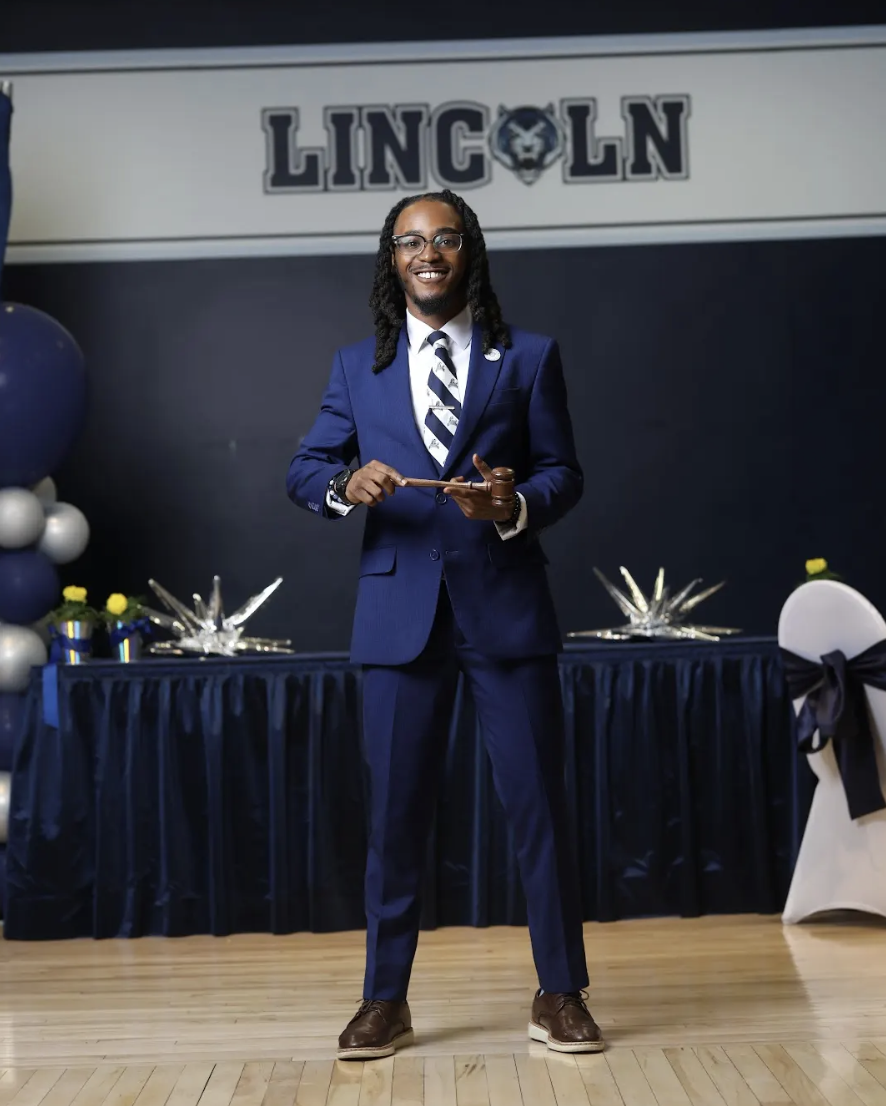
We interviewed Jesse Canamore and talked to him about his position, goals, future and what it means to hold this type of leadership position in 2025–2026.
Read the full interview below.
What is the biggest thing you’ve learned as a student government president so far?
Student leadership expanded my understanding of learning as a lifelong process and challenged me to see the bigger picture beyond titles or positions. The most effective leaders are those who remain open to guidance, from both the people they serve and those they lead. One of my greatest lessons has been the importance of adaptability and relatability. Adaptability prevents complacency and equips leaders to navigate change and pressure with confidence, while relatability allows leaders to inspire others not just to follow, but to see themselves as leaders as well.
Serving as SGA President reinforced for me that individual strength is valuable, but collective leadership is transformative. Raised as an only child, I was taught independence and self-reliance, yet my leadership journey affirmed a lesson often emphasized in church and community: success is built through collaboration—it truly takes a village.
What made you decide to attend Lincoln University of Missouri for undergrad?
As a first-generation college student on both sides of my family, navigating higher education came without a roadmap. While my parents—a pastor and an educator—deeply valued education, the process of pursuing and selecting a college required faith, independence, and self-discovery. Graduating from high school in 2021, in the aftermath of the COVID-19 pandemic, I was recruited to play football and considered offers from institutions ranging from Division II to NAIA. Although each campus had its strengths, none initially felt like home.
I ultimately chose Lincoln University for the balance it offered—far enough from St. Louis to allow me to grow into my own identity, yet close enough to remain connected to my family. Raised as an only child, that distance mattered. What ultimately solidified my decision was Lincoln’s alumni community, whose pride, presence, and legacy created a sense of belonging that extended beyond academics and athletics. Inspired by that connection, I committed not only to attending Lincoln University, but to making it my home and contributing meaningfully to its legacy.


How has Lincoln University of Missouri molded you into the person you are today?
While many values are shaped long before students arrive on a college campus, Lincoln University provided me with the network and institutional support necessary to build my own platform and sense of purpose. Growing up in St. Louis, Missouri—consistently ranked among the nation’s most dangerous cities—I witnessed how differences too often created division rather than empowerment. Attending an HBCU connected me to a culture of Black excellence and reshaped my understanding of the idea that one is not defined by their environment, but by how they rise beyond it.
Shortly after arriving on campus, however, my sense of direction was shaken. Just one month into my college experience, I lost my mother, Ann Canamore, on September 28, 2021. During that period of grief and uncertainty, it was Liz Morrow “Mama Liz,” a devoted staff member and campus caregiver, who ensured I felt supported and seen. When home no longer felt like home, she encouraged me to return to Lincoln by October 14th, so that I would not face hardship alone. She also advocated on my behalf by submitting an academic appeal that allowed me to remain enrolled after finishing the semester with a 1.6 GPA and being placed on academic suspension.
Experiences like these are why my commitment to Lincoln University runs deep. In my role as the first Mister Lincoln University of Missouri to also serve as Student Government Association President, I strive to embody the university’s oath—To transmit our university to those who come after us greater, better, and more beautiful than it was transmitted to us.


What specific initiatives have you headed up this year (or are planning) and how do you think they will improve the school and surrounding community?
During this academic year, I have had the honor of serving not only Lincoln University, but also the broader HBCU community and our surrounding local communities. As part of the 91st H.E.A.T. Administration—Helping Everyone Achieve Together—our leadership has focused on positioning students for success through inclusion, engagement, encouragement, and accountability. We expanded student leadership roles and supported the growth of student-led organizations to ensure broader representation and participation across campus.
Our administration prioritized engagement and transparency through increased Town Hall meetings and the launch of Notify 91, a student-to-student communication platform designed to serve future administrations. In partnership with our Royal Court, we also adopted Thorpe Gordon Elementary School, launching “High Five Friday,” a weekly initiative centered on encouragement and community service. Academically, data-driven initiatives such as campus-wide study nights contributed to 47.6 percent of enrolled students earning placement on the Dean’s List—the highest rate in ten years.
Looking ahead, I am especially excited to launch Suited for the STORM, a program providing Lincoln men with free professional attire through the Blue Tiger Boutique to prepare them for life after graduation. I am also the founder of The M.A.L.E. Initiative (Men Achieving Leadership and Excellence), a campus organization dedicated to mentorship, leadership development, and community service, reinforcing the belief that success is attainable through strong networks and collective support
How is your student government administration/school currently working on attending to the mental health of students?
Mental health remains my most significant priority both within and beyond student leadership, recognizing that education extends well beyond the boundaries of the classroom. This resulted in the establishment of the Blue Tiger Zen Den, a space dedicated to advancing mental health awareness. Starting as an initiative of the previous 90th Administration, the Zen Den is located within the university health center and serves as an isolation and relaxation room where students and staff can decompress, reflect, and reset. Licensed therapists are always present and readily available, though engagement is never mandatory, allowing students to seek support at their own comfort level.
One initiative I am encouraged by is the development of MindSpace, a mental health journaling application (created by my student leaders) designed to normalize emotional check-ins. With daily, weekly, and monthly reflection options, the app aims to connect mental health communication between students with selected counselors who can review check-ins and provide timely support, ensuring students have consistent access to care as they navigate academic, personal, and emotional pressures.
In addition, the administration has implemented reflective questionnaires for both students and student leaders that address life experiences outside academic demands. I believe the first step toward mental health support is not immediately finding solutions, but identifying emotional and environmental triggers through intentional self-reflection. The diversity within our administration further strengthens this work, ensuring that a wide range of perspectives, backgrounds, and lived experiences inform decision-making.

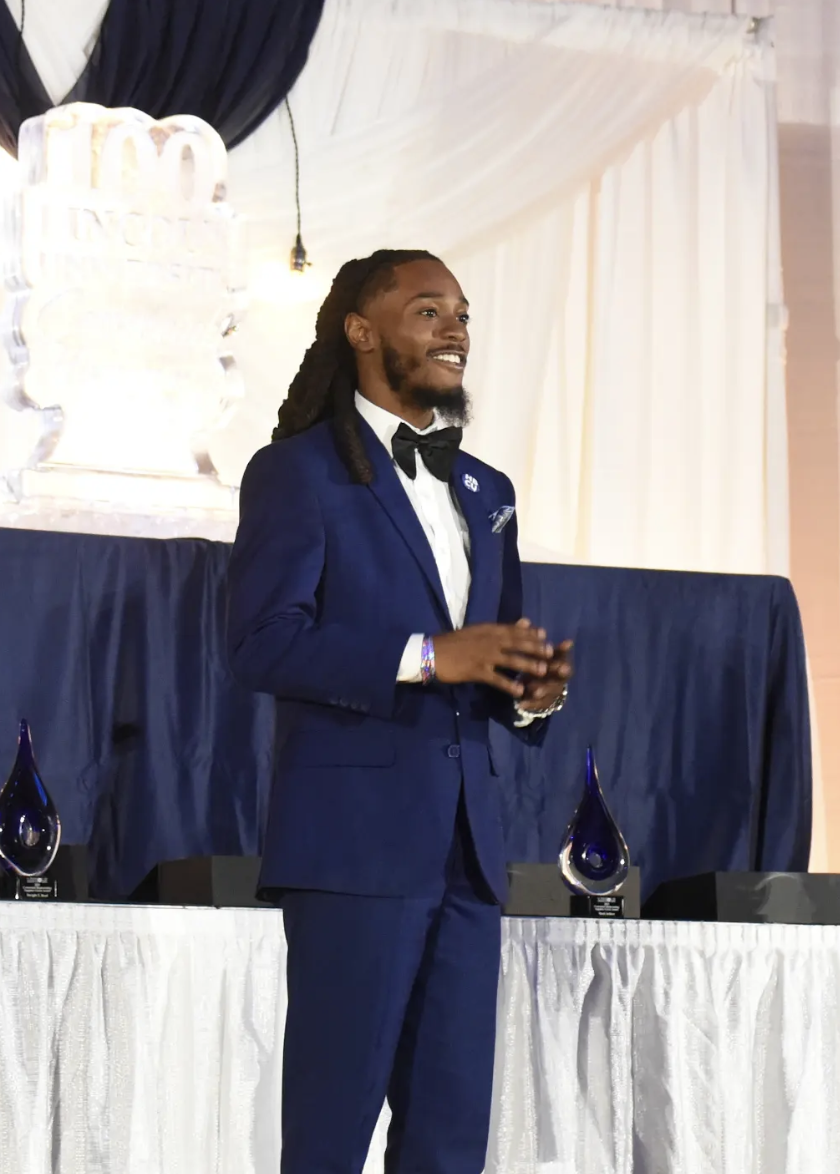
What does leadership mean to you?
Leadership holds deep meaning for me, shaped by the privilege of serving not only in student leadership roles but also in positions beyond academia. From serving as SGA President and Mister Lincoln University, to founding organizations and leading as a varsity football captain, I have learned that leadership is rooted not in titles, but in trust in oneself and from others. Titles hold little value without the work, vision, and self-belief behind them. True leadership, in my experience, is the ability to embody a confidence so genuine and consistent that it inspires even the most skeptical to believe in what is possible.
Equally important, leadership is defined by the ability to influence, impact, and engage those you serve. As I have often said, “Student leadership is meaningful, but without impact on the students, there is no one to lead.” Service is the foundation of lasting leadership. Legacy is not built on image alone, but through the intentional alignment of visibility and meaningful action. It is this combination of purpose-driven leadership and tangible impact that allows leaders to leave a lasting mark on their communities.
Sustaining leadership, however, requires resilience and authenticity. A true leader must embrace life’s challenges and transform adversity into opportunity. Being open, relatable, and human is essential to connecting with others, especially in spaces where everyone is searching for direction and purpose. I live by the principle of embracing the many “L’s” of life—Living, Loving, Laughing, and Learning—to leave a legacy. It is through loving, laughing, and learning that our losses become lessons, and our struggles are into strength.
We now live in a digital world, what do you think schools need to do to represent themselves online in 2025–2026?
To strengthen the image and visibility of HBCUs, it is essential to recognize that attention spans have shortened and content has become a primary measure of value and influence. In the post-pandemic era, Black culture has been a driving force behind what captivates audiences on social media. For too long, younger generations have been criticized for their immersion in the digital world rather than encouraged to harness it as a tool for connection and storytelling. For universities to continue to grow and remain relevant, they must meet the next generation where they are, leveraging technology and creativity that captures attention, engages the mind, and makes inclusion not just a goal, but the standard.

Why do you think Watch The Yard is important to Black students and college culture?
Watch The Yard is important to Black students and college culture because it celebrates and amplifies the achievements, traditions, and visibility of Historically Black Colleges and Universities (HBCUs). Combining culture, excellence, and awareness in a world without diversity, representation, and unity for all minorities.
The need for a Black history book has been long overdue. Watch the Yard’s website and social media help connect students to history, communities, and movements larger than ourselves. Inspiring younger generations to pursue higher education and embrace their identity like never before.
What do you plan on doing after graduation?
I plan to continue my studies in law and politics through law school, deepening my commitment to community engagement and mentorship. Whether I pursue a career as a lawyer or campaign again as an elected official, my goal is to use my image and platform for public speaking while serving as the representation and mentorship that minorities need both inside and outside of the justice system.
Alongside my academic and civic goals, I am committed to developing my craft in music. Though I began my music journey just over a year ago, I have already performed in six cities across eight stages. Rooted in my upbringing in church and early experiences playing the violin and drums, songwriting and producing have become powerful outlets for expression. While attending Lincoln University, I won four pageants—including two talent-based titles such as Mister Lincoln University of Missouri—and placed second in the 2025–2026 National Mister HBCU Competition. I never envisioned myself as a music artist until my mental health campaign song, “STORM” (Surviving The Odds Reality Made), was embraced by my student body and hometown and performed across multiple HBCU campuses and at NASAP SLI. My second song, “MERCY,” a gospel rap dedicated to my late mother, earned second place at the National Mister HBCU Competition in January 2025 and led to the opportunity to headline at South by Southwest (SXSW) in Austin, Texas. I closed the year by opening for nationally recognized artists G Herbo and Bunna B during Lincoln University’s historic 100th Homecoming celebration.
Leadership, to me, is the responsibility to serve, represent, and uplift others using every platform I am given. Through leadership, law, and music, my purpose remains the same: to serve boldly, speak honestly, and create space for others to rise—especially those whose who are fighting “Through the STORM”.
We at Watch The Yard would like to commend Jesse Canamore for his work as the student government president of Lincoln University of Missouri.
Photo Credits: @Sleptoncam7